Quantum vs AI in healthcare: How they differ and why leaders must prepare for convergence

The AI and quantum convergence can accelerate progress in healthcare Image: Getty Images/iStockphoto
- AI already improves efficiency, diagnostic accuracy and patient access but classical computing cannot model complex molecular interactions or detect ultra-early disease signals.
- Quantum computing, sensing and communication are moving from theory to early clinical use. Combined with AI, these technologies can accelerate drug discovery, enable earlier diagnostics and secure health data.
- Building quantum-safe cybersecurity, launching pilot projects to gain institutional experience and upskilling teams in AI-quantum capabilities are key to moving the AI and quantum convergence towards greater gains.
A cardiac patient arrives at the emergency room with chest pain. Within minutes, a quantum magnetocardiography sensor detects subtle electrical anomalies that traditional electrocardiograms (ECGs) cannot capture, flagging a life-threatening condition before irreversible damage occurs.
This is not a vision of the distant future; it is being validated today at Mayo Clinic and it signals a new inflection point in healthcare.
Artificial intelligence (AI) is already transforming the frontline of care but quantum technologies are emerging to solve the scientific and computational challenges that AI and classical systems alone cannot reach.
The question for health and healthcare leaders is no longer whether quantum will reshape medicine; it is whether their systems will be ready to participate in and benefit from that transformation.
Precision, efficiency and system-level value
AI has rapidly become integral to clinical operations. From automated documentation to imaging analysis and predictive triage, AI-driven tools are accelerating workflows and reducing administrative burdens.
The AI-in-healthcare market is projected to reach $491 billion by 2032, growing at 43% annually, reflecting how quickly these tools are being embedded into healthcare operations.
AI delivers value today by:
- Reducing clinician workload through automated notes, claims processing and triage support.
- Strengthening diagnostic precision, particularly in imaging, where over 70% of US Food and Drug Administration-cleared AI tools currently focus.
- Expanding patient access through virtual care, monitoring and earlier detection capabilities.
Yet AI remains limited by classical computing. It can analyse data patterns at scale but it cannot model the quantum-level interactions that underpin biology or simulate complex molecular behaviour. Nor can it detect ultra-early disease signals that exist below classical measurement thresholds.
This is precisely where quantum enters.
Quantum’s emerging role tackling biology’s hardest problems
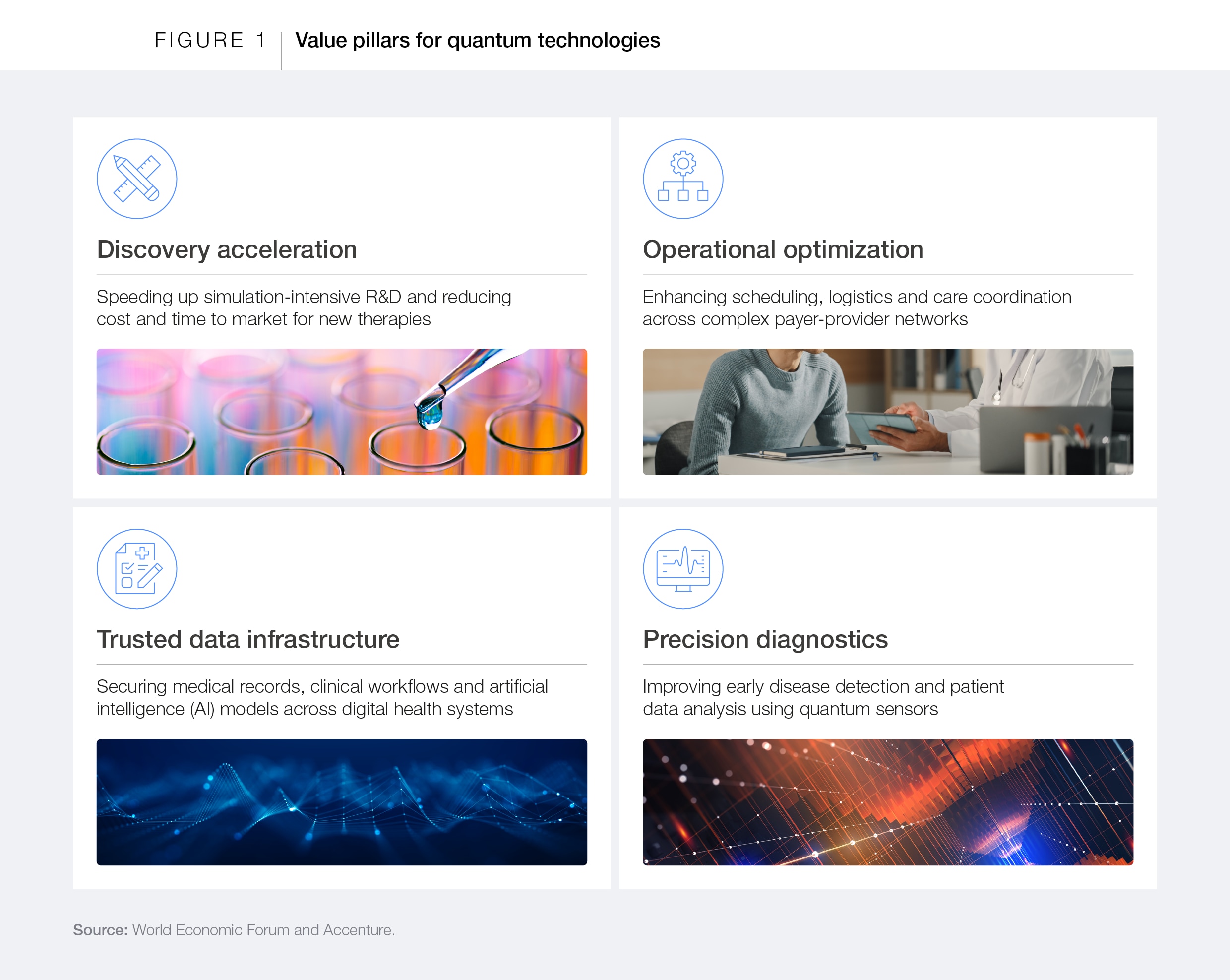
Quantum technologies spanning quantum computing, sensing and communication are advancing to address challenges fundamental to biomedical research and clinical care.
The World Economic Forum’s white paper, Quantum Technologies: Strategic Imperatives for Health and Healthcare Leaders, outlines four value pillars where quantum is gaining traction, as shown below.
AI has accelerated drug discovery, yet still struggles to predict toxicity, model biological mechanisms and identify early disease signatures. Quantum technologies target these gaps.
Quantum chemistry has the potential to simulate molecular and biological systems with physical accuracy; quantum sensing to detect real-time, non-invasive magnetic and bioelectric signals; and quantum communication to secure electronic health records, clinical workflows and AI pipelines in a post-quantum world.
These capabilities extend what AI alone can achieve.
Moving from theory to clinical reality
Early deployments are already reshaping practice. IBM and Cleveland Clinic are advancing quantum-enabled biomedical research; Mayo Clinic is trialling quantum magnetocardiography for faster cardiac triage; the University of Chicago and Wellcome Leap are exploring quantum-enhanced biomarker discovery; and European consortia are building quantum-secure communication networks.
Quantum technologies are moving beyond theory into early clinical settings.
The Moderna-IBM collaboration illustrates the AI-quantum synergy. Classical AI accelerates candidate optimization but struggles to model Ribonucleic Acid (RNA) folding complexity. Quantum computing can evaluate these interactions, while AI interprets results and orchestrates the hybrid workflow.
In early pilots, quantum algorithms produced greater “solution diversity,” surfacing viable therapeutic designs that classical systems overlooked and reduced modelling timelines from weeks to hours. Quantum expands the scientific landscape; AI enables its practical use.
2 technologies, distinct timelines, 1 strategic destination
AI and quantum operate on fundamentally different adoption horizons:
- AI’s horizon is immediate, delivering measurable gains in efficiency, accuracy and access today.
- Quantum’s horizon is transformational, requiring investment now to unlock breakthroughs that could redefine how we detect, treat and understand disease.
This asymmetry is not a tension but an opportunity. AI strengthens the digital and operational foundations of healthcare, while quantum expands the boundaries of what science and computation can achieve. Their convergence will enable earlier detection, more precise therapies, resilient data infrastructures and new scientific capabilities.
Whether that convergence is seamless or fragmented depends on choices leaders make now: how data frameworks are structured, how interoperability standards evolve, how governance and cybersecurity models adapt and how workforces are prepared.
The sector will only be ready if today’s AI foundations are robust and future-proof.
How the Forum helps leaders strengthen health systems through collaboration
Shared challenges: Governance, talent and trust
Both AI and quantum face shared systemic challenges that require coordinated action:
- Governance complexity across fragmented regulations.
- Talent shortages spanning quantum technologists to AI-literate clinical leaders.
- Equity risks, as digital infrastructure remains uneven, potentially concentrating quantum diagnostics in elite institutions while underserved communities fall further behind.
- Interoperability gaps that could limit both technologies’ scale.
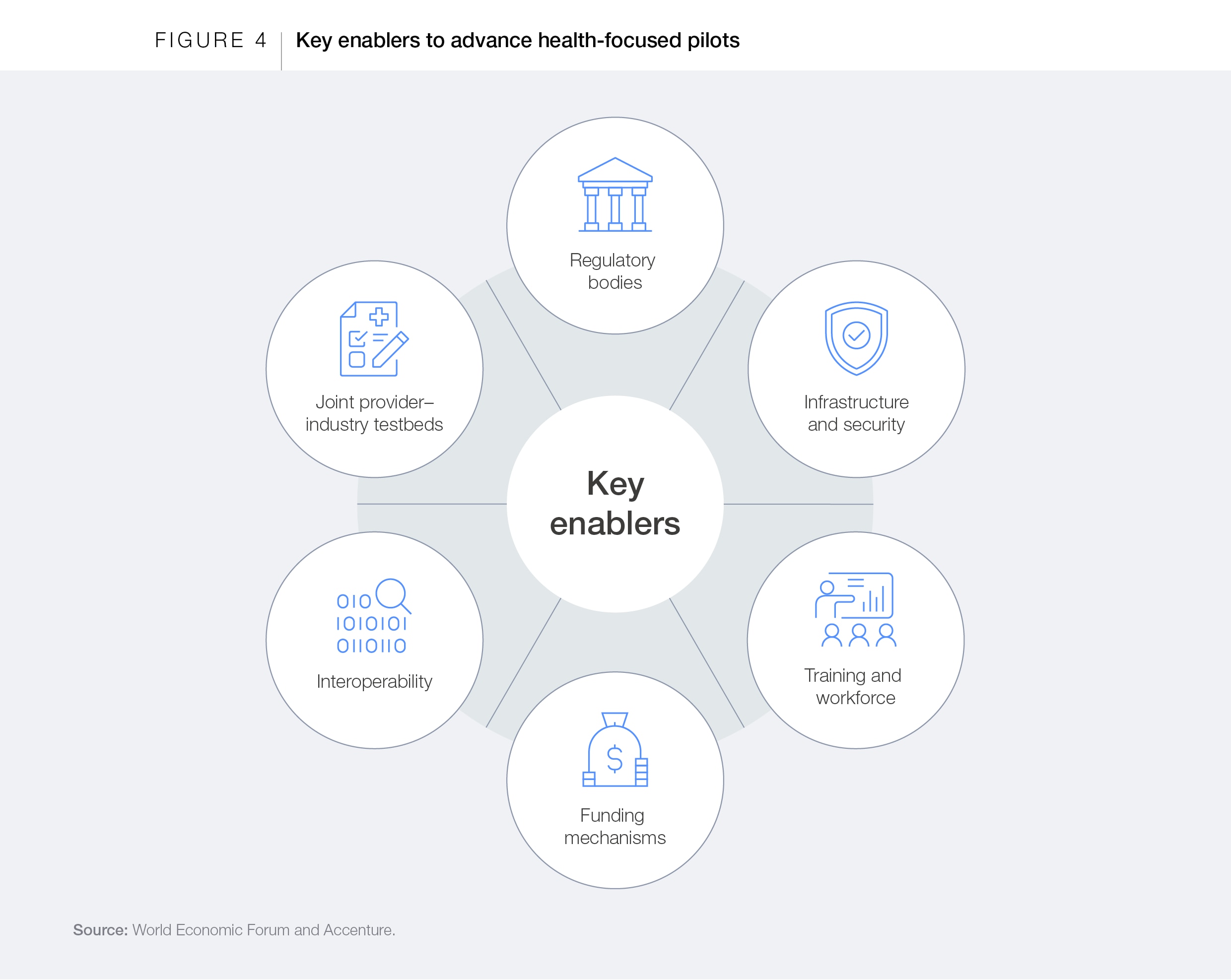
As highlighted in Figure 4 of the World Economic Forum white paper, advancing quantum and AI requires enabling pillars. Addressing these enablers for AI today will accelerate readiness for quantum tomorrow.
3 strategic actions for health and healthcare leaders
To navigate the coming AI-quantum convergence, health and healthcare leaders should prioritize three strategic actions.
1. Strengthen quantum-safe data foundations
Assess which systems rely on encryption vulnerable to future quantum attacks and align cybersecurity strategies with emerging post-quantum standards.
2. Launch targeted pilots to build institutional capability
Explore high-value use cases, such as quantum sensing in diagnostics or quantum-enhanced modelling, through partnerships with industry, academia or consortia. Early pilots build organizational learning and shape standards.
3. Prepare the workforce and governance structures
Integrate quantum literacy into leadership development, procurement criteria and research and development strategies. Foster cross-functional teams that understand AI-quantum hybrids and guide responsible adoption.
Why it matters now
For decades, healthcare innovation has arrived in waves. AI is the wave reshaping our systems today; quantum is the one rising behind it. Together, they can create a health and healthcare ecosystem that is more predictive and preventive, more secure and more scientifically capable.
This is not a moment for hesitation but for deliberate, forward-looking action. Leaders who prepare now by strengthening foundations, investing in pilots and shaping governance will not simply adopt the future of healthcare; they will help define it.
Those choices will determine whether quantum technologies deepen global health equity or widen existing divides and whether breakthroughs reach patients in time to transform outcomes.
Don't miss any update on this topic
Create a free account and access your personalized content collection with our latest publications and analyses.
License and Republishing
World Economic Forum articles may be republished in accordance with the Creative Commons Attribution-NonCommercial-NoDerivatives 4.0 International Public License, and in accordance with our Terms of Use.
The views expressed in this article are those of the author alone and not the World Economic Forum.
Stay up to date:
Artificial Intelligence-Facilitated Healthcare

Forum Stories newsletter
Bringing you weekly curated insights and analysis on the global issues that matter.
More on Health and Healthcare SystemsSee all

Shyam Bishen, Lucy Perez, Cuilin Zhang and Chong Yap-Seng
January 7, 2026


