Beyond borders: how new trade and investment corridors are reshaping global business
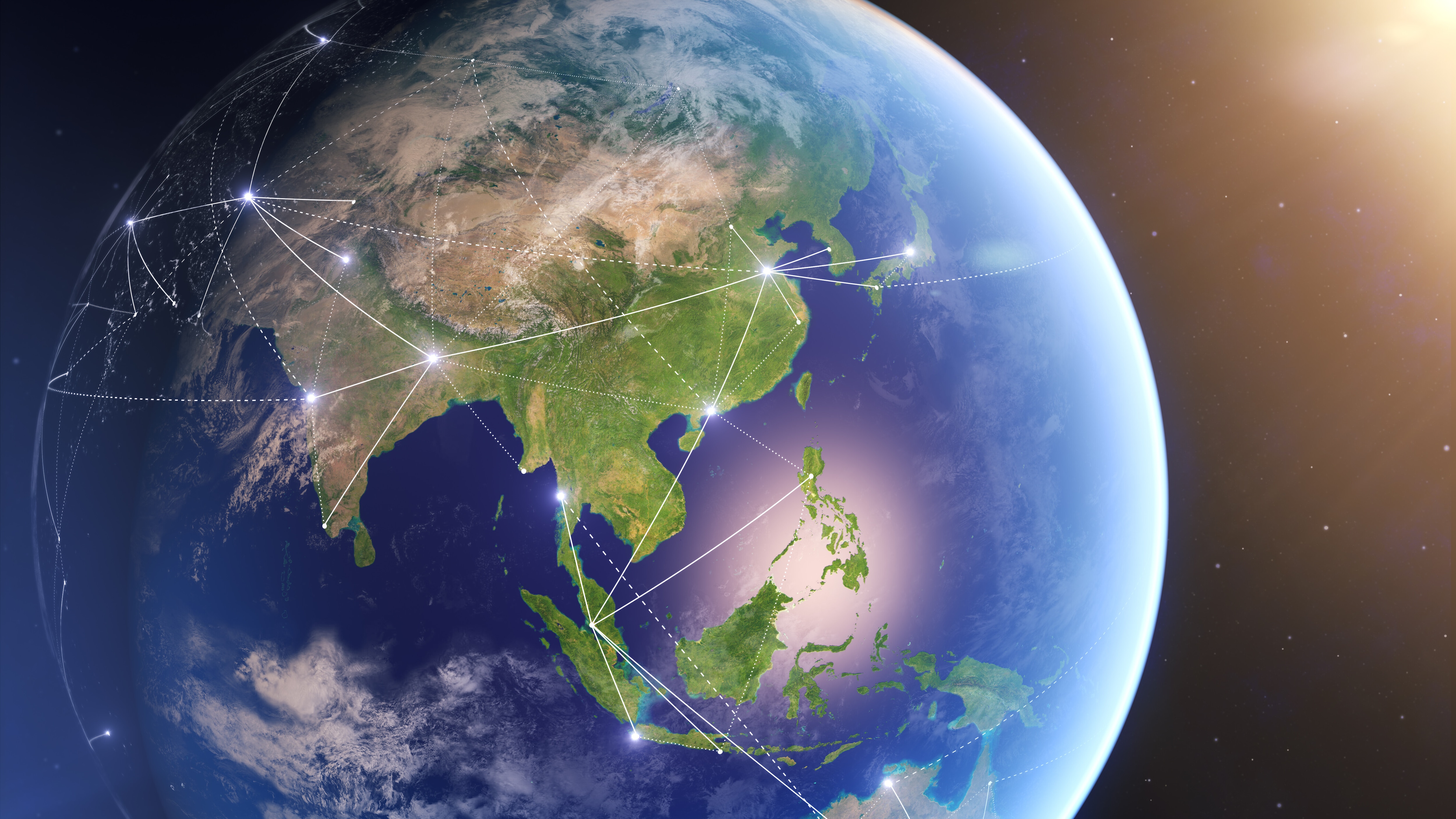
Recent trade and investment deals are reshaping the trade landscape in ways that multinational corporations cannot ignore. Image: Getty Images
- With multilateral trade frameworks under strain and global rules in flux, a more transactional style of international relations is taking hold.
- Recent trade and investment deals are reshaping the trade landscape in ways that multinational corporations cannot ignore.
- The centres of economic power are evolving and firms must adapt, which requires engagement with governments in public-private dialogue.
There is currently an unprecedented level of disruption in the global economy. This disruption stems from a combination of multiple complex factors, from the fallout from Brexit and the COVID pandemic to current widespread geopolitical tension, armed conflicts and global tariff wars.
With national security and geopolitical disruption now firmly on the C-suite agenda, the advent of the “Chief Geopolitical Officer” underscores how corporations are racing to mitigate risks from sanctions, export controls, foreign investment controls, and other regulatory measures.
Changing of the guard
It is important to note that while there may be whispers that the old world order – that of multilateralism – is dying, roughly 72% of world trade is still conducted under World Trade Organization most-favoured nation (MFN) rules, despite a recent downturn. This is a clear reminder that multilateral trade is still very much relevant, and we should not abandon it and the principles on which it was founded.
However, with these traditional multilateral trade frameworks under strain, and global rules in flux, a more transactional style of international relations is taking hold. Countries and companies also appreciate that overreliance on any single trading partner is now a vulnerability and, accordingly, diversification is a core business strategy.
This has allowed more nimble bilateral trade corridors to quickly emerge and become steering influences in global growth, and this has sizeable ramifications for multinational businesses. Recent trade and investment deals like UK-India, US-Japan, and EU-Indonesia cast a spotlight on the speed and simplicity of this new world – and they are reshaping the trade landscape in ways that multinational corporations cannot ignore.
Recalibrating growth: M&A as a resilience strategy
What does that mean for business? Simply put, volatility combined with fragmentation creates opportunities for those ready to engage – many more of them than when confined to a purely multilateral world. For instance, the new UK-India deal is touted to increase bilateral trade by £25.5 billion, and investment and M&A across these two markets will become easier.
A good example of adaptation to this new reality is in the transactional landscape. Global M&A activity has rebounded strongly after a period of uncertainty shaped by regulatory pressures and geopolitical shifts. By mid-November, global M&A volumes had surged to $4.3 trillion – up 39% year-on-year – driven by strong appetites for geographical diversification, technology-orientated investments and deals relating to the broader energy transition.
This isn’t an end-of-year flash, either. We are seeing clients looking at significant M&A growth for 2026, signaling sustained confidence despite volatility and geopolitical uncertainty shaping deal priorities and impacting valuations. The landscape in which we find ourselves isn’t slowing M&A – it’s simply recalibrating it. Companies are increasingly turning to strategic acquisitions (rather than an overreliance on organic growth) to secure resilience, access innovation and position for long-term advantage. Companies are adapting to the new world order to get the goods, services and capital flowing.
Alongside this, regulatory agility is fast becoming a sought-after competitive advantage. As foreign investment and national security regimes tighten, companies are prioritising foresight and geopolitical alignment in M&A strategies, with an emphasis on early risk assessment, deal structuring to minimise scrutiny, and investments in ‘friendly’ jurisdictions or nearshoring to maximise deal feasibility.
In the global M&A market, the evolving environment is clearly rife with opportunity for companies that set their strategies and priorities accordingly – and navigate the complex regulatory landscape that is now heavily infused with national security. This requires not only a global perspective, but also the local expertise and in-market understanding of those national security drivers (which can vary materially from one country to the next).
Thriving in a multipolar world
Adaptation also requires the acknowledgement that global trade is becoming increasingly multipolar. While the US and China will undoubtedly remain economic powerhouses, companies must now keep a closer eye on what’s happening elsewhere in the world to navigate this new, more complex framework. With global trade growth strongly underpinned by South-South trade (c.8% growth year-on-year as of October), the old way of focusing on a small handful of high-value markets has been replaced by a plethora of smaller, but highly profitable opportunities.
For companies to truly thrive today, they cannot simply look to the US, or to the UK, or to China. They must diversify, and strategically so, into the emerging economies of the world, where growth is predicted to outstrip that of advanced economy nations by a ratio of over 2.5:1. The centres of economic power are evolving, and companies must either adapt or stagnate.
For companies, this not only requires careful planning and expert advice, but also engagement with governments in public-private dialogue. There is fast-paced change afoot, and governments have a lot to consider – they may not pick up on specific sectoral opportunities. Companies therefore must be proactive in helping to steer the direction of new free trade agreements and investment understandings. For example, are there regulations that require improvement, or barriers that can be removed that currently dampen trade and investment? This sort of collaboration is a win-win for both companies and governments.
Companies must also impress upon their governments the importance of continued bilateral discussions, not only to grease the wheels of trade, but to ensure that further conflicts are avoided. The more volatile or underserved the relationship between nation states, the more likely the risk of regulatory conflict between them. This escalated risk leads to national security further infiltrating business relations, which contributes to an increased sclerotisation of global trade.
The current environment lends itself to risk mitigation strategies: companies are friendshoring and restructuring supply chains to reduce exposure to hostile jurisdictions; deal insurance is rising in volatile regions; political and economic turbulence is being priced into deal strategies. But the world is rife with opportunity for those who can boldly rise above the risk and see the horizon – providing they have both the global perspective and the in-market expertise, preparation and agility to capitalize in 2026.
Don't miss any update on this topic
Create a free account and access your personalized content collection with our latest publications and analyses.
License and Republishing
World Economic Forum articles may be republished in accordance with the Creative Commons Attribution-NonCommercial-NoDerivatives 4.0 International Public License, and in accordance with our Terms of Use.
The views expressed in this article are those of the author alone and not the World Economic Forum.
Stay up to date:
Geo-economics
Related topics:

Forum Stories newsletter
Bringing you weekly curated insights and analysis on the global issues that matter.
More on Trade and InvestmentSee all

Sean Doherty
December 18, 2025


